


Relief and the Sacred Monument: Entering the Space
September 3 @ 5:00 pm - 6:15 pm
Relief and the Sacred Monument: Entering the Space
Date: 3 September 2026 (Thu)
Venue: CPD-2.58, Centennial Campus, HKU (directions)
All are welcome, no prior registration needed, free seating
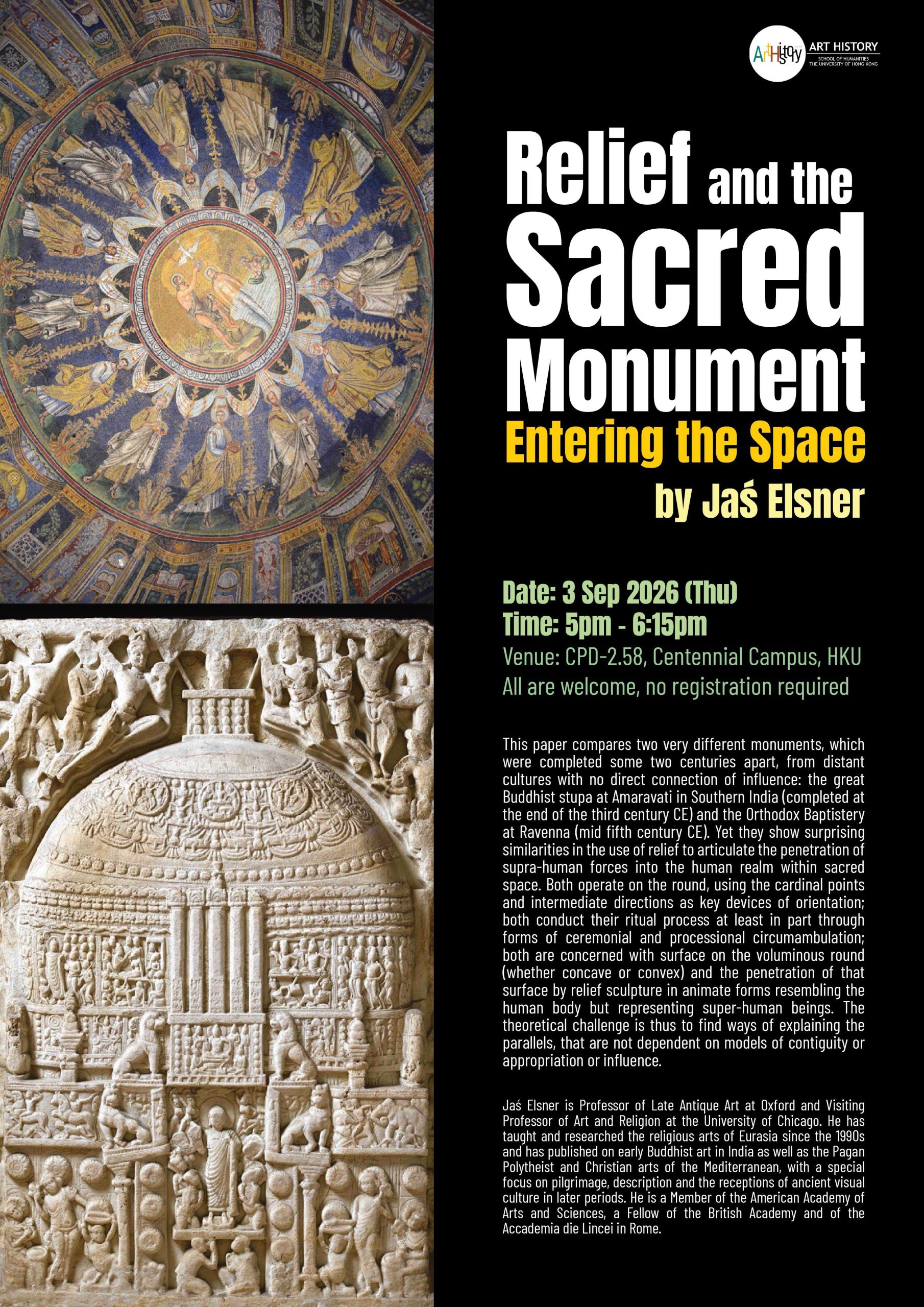
Abstract: This paper compares two very different monuments, which were completed some two centuries apart, from distant cultures with no direct connection of influence: the great Buddhist stupa at Amaravati in Southern India (completed at the end of the third century CE) and the Orthodox Baptistery at Ravenna (mid fifth century CE). Yet they show surprising similarities in the use of relief to articulate the penetration of supra-human forces into the human realm within sacred space. Both operate on the round, using the cardinal points and intermediate directions as key devices of orientation; both conduct their ritual process at least in part through forms of ceremonial and processional circumambulation; both are concerned with surface on the voluminous round (whether concave or convex) and the penetration of that surface by relief sculpture in animate forms resembling the human body but representing super-human beings. The theoretical challenge is thus to find ways of explaining the parallels, that are not dependent on models of contiguity or appropriation or influence.
Speaker: Jaś Elsner is Professor of Late Antique Art at Oxford and Visiting Professor of Art and Religion at the University of Chicago. He has taught and researched the religious arts of Eurasia since the 1990s and has published on early Buddhist art in India as well as the Pagan Polytheist and Christian arts of the Mediterranean, with a special focus on pilgrimage, description and the receptions of ancient visual culture in later periods. He is a Member of the American Academy of Arts and Sciences, a Fellow of the British Academy and of the Accademia die Lincei in Rome.
Find us on…